
Welcome to the Mathematical World!
Wilhelm Röntgen
Discoverer of X-Rays
Wilhelm Conrad Röntgen (1845–1923) was a German physicist who discovered X-rays, a groundbreaking achievement that revolutionized medical imaging and physics. He was born in Lennep, Germany, and studied mechanical engineering and physics at the Polytechnic in Zurich. Röntgen spent much of his career as a professor at several universities, including the University of Würzburg, where he made his historic discovery.
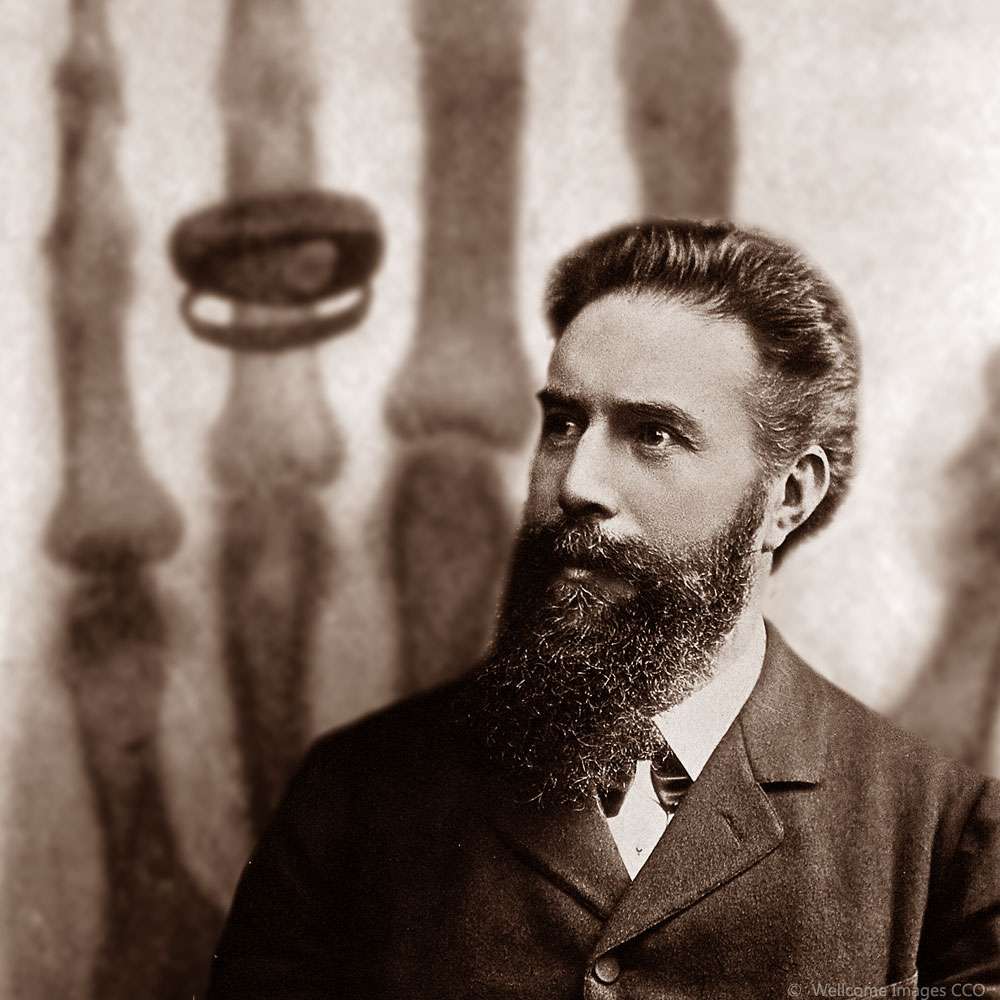
Discovery of X-Rays
In 1895, Röntgen was experimenting with cathode rays when he noticed that a fluorescent screen across the room glowed even though it was not in the direct path of the rays. He realized that a new type of invisible radiation was being emitted. He called these rays X-rays due to their unknown nature at the time.
He demonstrated that X-rays could pass through soft tissues but were absorbed by denser materials like bone and metal, producing the first radiograph — an image of his wife’s hand:
- Soft tissue appeared dark
- Bone appeared light
Impact on Medicine and Science
The discovery of X-rays had an immediate and profound impact:
- Enabled non-invasive internal imaging of the human body
- Advanced medical diagnostics and surgery
- Opened new areas of research in physics, particularly electromagnetism and radiation
Röntgen’s work laid the foundation for modern radiology. Mathematically, the attenuation of X-rays passing through a material of thickness \( x \) can be expressed as:
\[ I = I_0 e^{-\mu x} \]where \( I \) is the transmitted intensity, \( I_0 \) is the initial intensity, and \( \mu \) is the linear attenuation coefficient of the material.
Awards and Legacy
For his discovery, Röntgen was awarded the first Nobel Prize in Physics in 1901. He is remembered as a pioneering experimental physicist whose work transformed both science and medicine. Today, the unit of X-ray exposure, the roentgen, bears his name, and X-ray technology remains central to medical diagnostics and scientific research worldwide.

All rights reserved by the Mathematical Unity
Contact: +8801400044645
Email: mathematicalhorse1453@gmail.com
Our Discord Server: Mathematical Unity [Ulus Riyadiyat]